


The Pathology of Sadism
- Ada Özel

- Nov 20, 2025
- 3 min read
Sadism refers to deriving pleasure from the pain or suffering of others. Some individuals actively inflict harm, while others are satisfied by merely observing it. This harm may manifest in physical, emotional, psychological, or sexual forms. In everyday contexts, individuals with sadistic tendencies may attempt to control others, publicly humiliate them, or misuse power to cause harm.
Sadism frequently co-occurs with other personality traits, including psychopathy, narcissism, and Machiavellianism. Machiavellianism is characterized by manipulativeness, strategic behavior, and a willingness to exploit others for personal gain. Due to the frequent association of sadism with these traits, psychologists have classified them collectively as the Dark Tetrad (Paulhus, 2014). Individuals with high levels of sadism typically exhibit low empathy and guilt, display cruelty, and may be fascinated by violence, weapons, or humiliation. Research wrote that approximately 7% of students report mild or 'subclinical' sadistic traits; however, the actual prevalence may be higher, as such behaviors are often concealed in self-report surveys .
Historically, sadism was considered for inclusion in the Diagnostic and Statistical Manual of Mental Disorders (DSM) as a personality disorder. It was excluded due to significant overlap with antisocial and narcissistic personality disorders. In contrast, sexual sadism disorder remains in the DSM and is classified under algolagnic disorders, in which sexual arousal depends on pain or humiliation.
Neuroscientific research on sadism shows why certain individuals feel pleasure from cruelty or exerting control over others. A significant finding concerns the brain's reward system. Studies involving individuals with psychopathic or antisocial traits, which are closely linked to sadism, show elevated dopamine activity in the nucleus accumbens, a central component of the reward system. For some sadistic individuals, inflicting harm or dominance may activate the same neural pathways associated with positive reinforcement.

Another relevant factor involves the neural processing of pain and emotions. Neuroimaging studies indicate that sexual sadists exhibit heightened activation in the amygdala and anterior insula when observing others in pain, compared to the control group. These brain regions are involved in emotional processing and interoceptive awareness. This evidence suggests that sadists may experience intensified emotional or arousal responses when witnessing suffering.
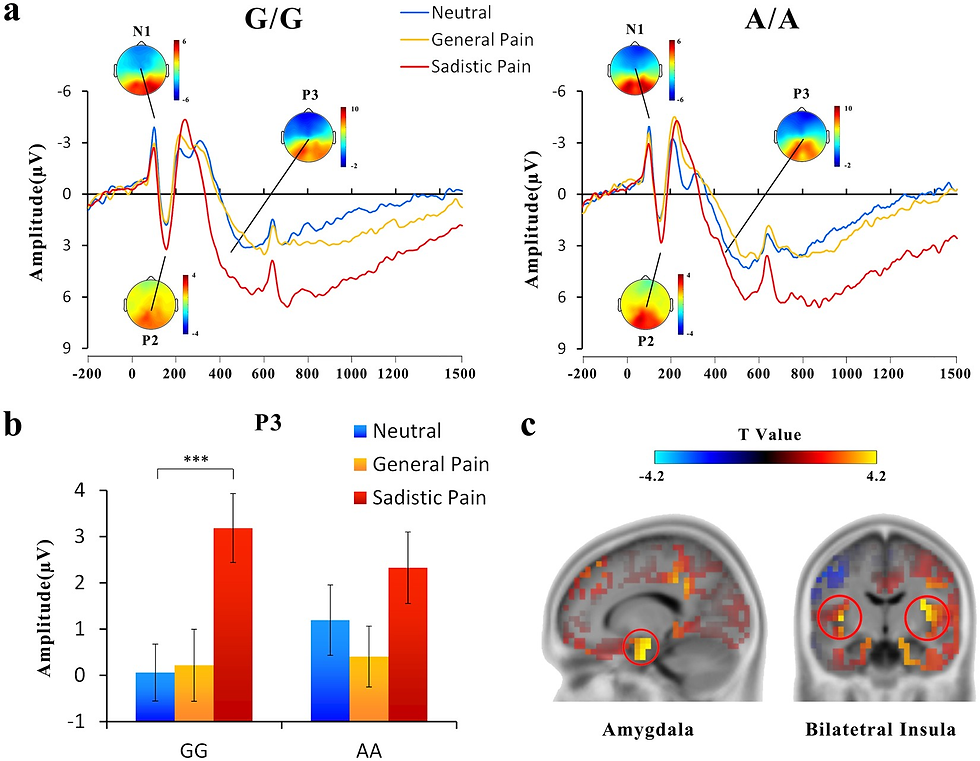
Research also shows stronger functional connectivity between the amygdala and anterior insula in sadistic individuals. This means the two brain areas work more closely together, which may help explain how another person’s pain can turn into a feeling of pleasure or power for them.
Finally, some studies suggest that sadists may have weaker activity in brain circuits that control self-control and responses to negative consequences, such as the dorsal anterior cingulate cortex, lateral orbitofrontal cortex, and lateral habenula. If these systems don’t work well, it may be harder for the person to stop harmful impulses.
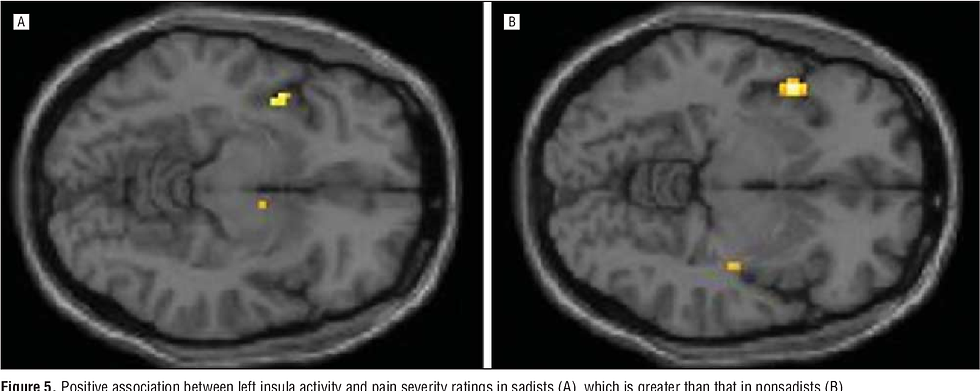
Sadism is a complex psychological construct that involves personality traits, behavior patterns, and neurological factors. Overactive reward systems, stronger emotional reactions to others’ pain, and weaker self-control circuits may all contribute to why some people enjoy hurting others or seeing them suffer. Even though non-sexual sadism is not an official disorder in the DSM-5, growing research in neuroscience and personality psychology suggests it may need more recognition. Understanding how sadism works can help clinicians assess risk, create better treatment plans, and understand harmful behavior more deeply.
References
American Psychiatric Association. (2013). Diagnostic and statistical manual of mental disorders (5th ed.).
Buckels, E. E., Jones, D. N., & Paulhus, D. L. (2013). Behavioral confirmation of everyday sadism. Psychological Science, 24(11), 2201–2209.
Buckholtz, J. W., Treadway, M. T., Cowan, R. L., Woodward, N. D., Li, R., Ansari, M. S., et al. (2010). Mesolimbic dopamine reward system hypersensitivity in individuals with psychopathic traits. Nature Neuroscience, 13(4), 419–421.
Graziano, A. M. (2013). An integrated model of emotion regulation and self-control circuits. arXiv preprint arXiv:1304.4201.
Harenski, C. L., Harenski, K. A., Shane, M. S., & Kiehl, K. A. (2012). Aberrant neural processing of moral violations in criminal psychopaths. Journal of Abnormal Psychology, 121(3), 863–875.*
Knutson, B., Wimmer, G. E., & Lacey, S. C. (2014). Emotion–pain coupling in sexual sadism: An fMRI study. Neuropsychologia, 62, 212–220.*
Paulhus, D. L. (2014). Toward a taxonomy of dark personalities. Current Directions in Psychological Science, 23(6), 421–426.*
Lobbestael J, Slaoui G, Gollwitzer M. Sadism and Personality Disorders. Curr Psychiatry Rep. 2023 Nov;25(11):569-576. doi: 10.1007/s11920-023-01466-0. Epub 2023 Oct 19. PMID: 37856033; PMCID: PMC10654167.


